Nordbo
Nordbo Elderberry Kids
coming later
ElderberryLiquid
Sambucus nigra / Elderberry
Price not listed

Elderberry · Decision hub
Elderberry (Sambucus nigra) is sold as syrups, liquid extracts, glycerites, capsules and blends, and the labels describe very different things — fruit versus flower, juice versus extract, one ingredient versus a formula with added vitamins. This hub explains what the label terms mean and how to compare real products on the facts that are actually declared, without declaring a winner.
Pick your question
Pick the question closest to yours. Each one opens the existing HerbParlor tool or comparison that answers it — no sponsored rankings, no hidden ordering.
Start here
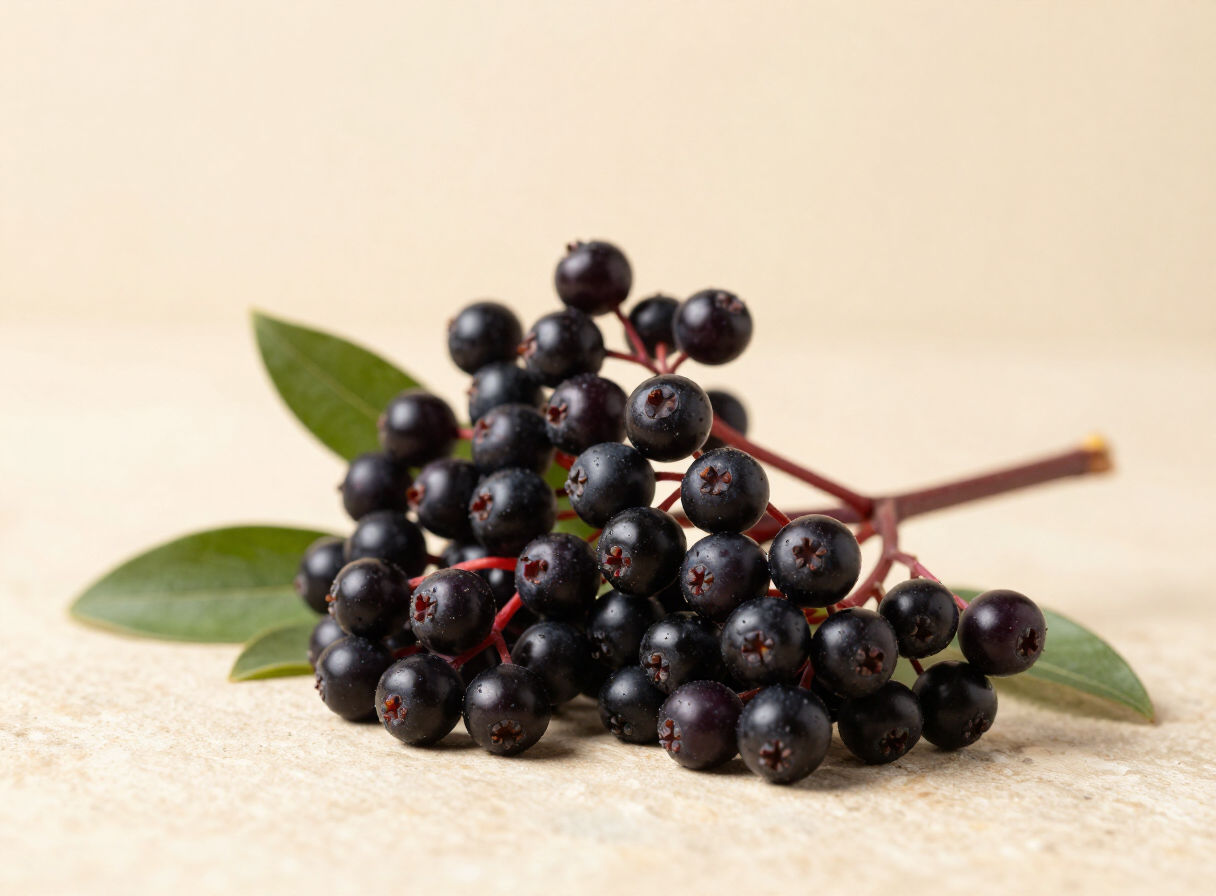
Elderberry supplements are made from the fruit of Sambucus nigra, the common or black elder. They are sold as syrups, juices, liquid extracts, glycerites, capsules, tablets and combination formulas. These are different preparations, and the milligram figure on one label is not automatically comparable with another.
Some labels declare a fruit or berry weight, some a fruit extract, some a juice concentrate, and some a proprietary blend of fruit, flower and extract. Elderberry fruit and elderflower are different plant materials and should not be treated as interchangeable. A standardized extract tested in one study is not automatically equivalent to every product on the shelf.
This hub does not recommend a particular elderberry form, amount or product for any health outcome. It explains what labels mean and how to compare products on declared facts. For what elderberry is, its botany and its research in depth, see the elderberry herb profile. Whether an elderberry supplement is appropriate is a decision for a healthcare professional — especially during pregnancy or nursing, or when taking medicines.
Forms & sources
These terms describe how elderberry is presented on a supplement label. The facts that matter for comparison are the form, the plant part, the declared amount per serving and any standardization information — read together, not in isolation.
Health benefits / health context
Elderberry has a long history as a European food and traditional preparation, and its fruit contains naturally occurring plant compounds that have been studied. Human research around colds, influenza and upper respiratory infections is limited and varies by preparation.
This section describes elderberry in general terms. It does not claim that any elderberry supplement treats, prevents or cures any condition, including colds, influenza or COVID-19. Whether an elderberry supplement is appropriate for a specific concern is a decision for a healthcare professional.
What research says
Human trials of elderberry are few, vary in preparation and population, and do not all point the same way. The summary below orients you; it is not a treatment or dosing recommendation.
What the research landscape looks like
A systematic review of randomized trials did not establish that elderberry reduces the risk of developing a common cold. It reported that elderberry may reduce duration or severity of colds, but with low or uncertain certainty.
A randomized, placebo-controlled trial in emergency room patients with confirmed influenza found no evidence that elderberry extract reduced duration or severity. The study was relatively small and described its findings as conflicting with earlier work.
A randomized, placebo-controlled trial in air travellers evaluated one standardized elderberry extract. This is preparation-specific evidence and should not be generalized to every elderberry product.
A review of Sambucus nigra subspecies describes variation in phenolic compounds, nutrients and naturally occurring cyanogenic glycosides. Chemical composition is not clinical efficacy.
Intake & dosage reference
There is no established recommended daily intake or tolerable upper intake level for elderberry supplements. Amounts vary widely across syrups, extracts, capsules and blends. This is general reference information for understanding labels, not an individualized dose.
| Group | Reference value |
|---|---|
| Common supplemental forms | Syrups, liquid extracts, glycerites, capsules, tablets and blends (amounts vary by product) |
| Recommended daily intake | No established daily reference value for elderberry |
| Tolerable upper intake level | Not established for elderberry |
| Studied dosing | Varies by study and preparation; not generalizable across products |
These are not personal dosing instructions. Studied amounts depend on the preparation, the population and the outcome, and a higher amount is not automatically better. Dosing for any clinical purpose is a decision for a healthcare professional.
Safety & side effects
Raw or unripe elderberries and other raw elder plant parts can contain poisonous cyanide-producing substances. Raw elderberries can cause vomiting, diarrhea and abdominal pain, and elderberries should be boiled for 15–20 minutes before consumption. Manufactured supplements are a different matter from picking and eating the berries, but it is why the species and preparation matter.
Safety information for elderberry supplements during pregnancy and breastfeeding is limited, and information on longer-term use is limited. These are general orientation points, not an exhaustive list.
Do not eat raw or unripe elderberries or other raw elder plant parts. If you experience vomiting, diarrhea or abdominal pain after consuming raw elderberry, seek advice from a healthcare professional.
Safety information during pregnancy and breastfeeding is limited. Whether an elderberry supplement is appropriate is a decision for a healthcare professional.
Symptoms of a respiratory illness that persist or worsen should be assessed by a healthcare professional rather than self-treated with a supplement. There is no good evidence supporting elderberry for COVID-19.
Interactions & important considerations
No clinically important medication interactions are established in the sources cited here, but the absence of a documented interaction does not mean there is no risk. Check with a pharmacist or doctor about your own medicines.
Sources
The context and terminology above are drawn from publicly available sources. HerbParlor does not independently verify the contents of third-party sites, and referencing a source here is not a treatment recommendation. Retailer listings that back product identity are kept separate from these sources.
Elderberry: Usefulness and Safety
National Center for Complementary and Integrative Health · Government health agency
National Center for Complementary and Integrative HealthRetrieved 2026-09-16
Hyldebær
Danish Veterinary and Food Administration · Government food authority
Danish Veterinary and Food AdministrationRetrieved 2026-09-16
Sambuci fructus
European Medicines Agency · Regulatory assessment
European Medicines AgencyRetrieved 2026-09-16
Elderberry for prevention and treatment of viral respiratory illnesses: a systematic review
PubMed / NCBI · Peer-reviewed literature
PubMed / NCBIRetrieved 2026-09-16
Elderberry extract outpatient influenza treatment: randomized trial
PubMed / NCBI · Peer-reviewed literature
PubMed / NCBIRetrieved 2026-09-16
Elderberry supplementation in air-travellers: randomized trial
PubMed / NCBI · Peer-reviewed literature
PubMed / NCBIRetrieved 2026-09-16
Bioactive compounds in three Sambucus nigra subspecies
PubMed / NCBI · Peer-reviewed literature
PubMed / NCBIRetrieved 2026-09-16
Decision criteria
No single elderberry product is “best” for everyone. These neutral criteria help you narrow the field to the products worth comparing side by side. Nothing here is influenced by affiliate availability, commission, merchant or a sponsored ranking.
A short, neutral pass before you commit. If you take medications, are pregnant or nursing, or have a medical condition, talk to your clinician before choosing any elderberry product.
Compare
Use the same criteria for every product. These are the facts HerbParlor structures and scores on — and the ones worth checking yourself before you decide.
Look for Sambucus nigra and whether the product is fruit, flower or both. They are different plant materials.
Syrup, juice, liquid extract, glycerite, capsule or tablet. Compare across forms by reading the declared amount and serving size together rather than treating the form name as a ranking.
Whether the figure is juice, dried fruit, fruit extract or an extract-equivalent. These are different measurements and are not interchangeable.
A named specification helps distinguish products but does not establish effectiveness. Do not assume a ratio or marker the label does not provide.
A proprietary blend may not disclose how much of each ingredient it holds. Added vitamins or minerals are separate considerations.
Syrups and some liquids contain sugar, honey or glycerin. These matter for people watching sugar intake and are part of the ingredient list.
Whether the product reports third-party testing or certifications, and whether that is independent verification or a brand or retailer claim.
VitaValue™ puts price next to a comparable quantity so serving size, form and packaging don’t disguise the real cost.
Tools
These are HerbParlor’s existing tools, contextualised for elderberry. Each one turns research into a shortlist you can act on — no sponsored rankings, no hidden ordering.
Start from your goal — not a product page — and get an evidence-aligned, scored shortlist.
Try the matcherEnter supplement label information and get a structured, neutral ingredient-by-ingredient analysis.
Analyze a labelPlace products side by side and see where each one earns — or loses — its score.
Open comparisonSee standardized cost per comparable unit so price sits next to what you actually get.
Calculate valueSee what testing and certification information HerbParlor has recorded for a product.
Check testing infoReview how much of a product’s profile is disclosed and documented across our eight dimensions.
Check transparencyCompare products
Every product below is a real, canonical record assessed with the same VitaScore™ rubric. Open any product for the full profile, or compare several side by side.
Nordbo
Sambucus nigra / Elderberry
Price not listed
Now Foods
Elderberry (Sambucus nigra) (fruit) · 500 mg · 10:1 concentrate
Price not listed
Solaray
Elderberry (Sambucus nigra) berry · 350 mg
Price not listed
Quantum Health
Elderberry Fruit (Sambucus nigra) Extract · 400 mg · 5% total flavonoids
Price not listed
Nature's Answer
Black Elderberry (Sambucus nigra) Juice · 12000 mg · concentrated from 12,000 mg black elderberries
Price not listed
Source Naturals
Elderberry Fruit & Flower Extract · 5 ml · 1:8 extract
Price not listed
Herb Pharm
Black Elderberry fruit (Sambucus nigra) extract · 828 mg · glycerite
Price not listed
Planetary Herbals
Elderberry fruit, elderberry flower extract, and elderberry fruit extract (proprietary blend) · Proprietary blend; individual component amounts not disclosed
Price not listed
Garden of Life
Elderberry
Price not listed
Learn
Editorial explainers that break down the labels, the chemistry, and the comparison framework behind this hub.
Elderberry herb profile
Botany, preparations, evidence and safety for Sambucus nigra.
How to Compare Supplements
The general framework behind every HerbParlor comparison.
How to Verify Third-Party Testing
What independent verification actually means — and what a claim is not.
Trust & methodology
Every elderberry product in this hub is assessed with the same transparent VitaScore™ rubric — eight dimensions covering label transparency, dose transparency, ingredient/form specificity, quality verification, source provenance, product/manufacturer transparency, evidence linkage and standardized value. The rubric is the same for every product and every category.
VitaScore™ is a transparency and documentation score. It is not a measure of medical effectiveness, safety or suitability for an individual. Missing information is reported as unavailable, never silently treated as a failure.
HerbParlor sells nothing and takes no placement fees. Scores cannot be bought, influenced, or negotiated.
We note when products report third-party testing, and say so when a product reports none. A manufacturer or retailer claim is never treated as independent verification.
Commercial relationships do not influence scores, ordering, or what appears on this hub. Retailer links appear only when verified and are kept separate from editorial analysis.
FAQ
This hub is provided for educational purposes only and is not medical advice. It does not claim that any elderberry form, source, or product is better for any health outcome. Always consult a qualified healthcare professional before starting any supplement, especially if you are pregnant, nursing, taking medication, or subject to anti-doping rules.